

Fellowship House’s Strategic Plan provides a realistic picture of the agency’s goals, including financial goals, program growth goals and service delivery goals. It helps the agency’s leadership determine a clear path to work towards so that we can maintain our position as the premier provider of psycho-social rehabilitation.

Who decides what the goals will be? We includes input from our Board of Directors, staff, funding sources, legislative trends, and most importantly- our members! We use many methods to communicate with our members and staff on a regular basis, including meetings, surveys, forums and informal communication to hear what is important and needed to meet our goals.

Secure permanent office space for Broward programs

  • Locate space that abides local use ordinances and is sufficient for the program’s staffing.
  • Renovate that space to accommodate use, including offices, member areas and all IT needs.
  • Effectively exit from temporary offices and relocate to new office space.

establish a second, fully operational fact 2 team

  • Identify and establish both office and program space for the FACT 2 Team.
  • Hire FACT 2 staff according to the ACT model and the Department of Children and Families FACT Handbook.
  • Work collaboratively with Thriving Mind in order to screen referrals and begin serving FACT 2 members as expeditiously as possible.

reduce paper usage across the organization

  • Transition all treatment plans to the Treatment Plan Builder format in AWARDS, allowing for electronic signature on all plans by members.
  • Conduct a review of any remaining internal paper forms and facilitate their transition to a paperless format (if allowable by contract, entity and statute) by the above identified date.
  • Regularly audit all documentation, including treatment plans and forms, for signature.

promote understanding of social factors affecting care

  • Encourage improved integrated behavioral and primary healthcare for our members.
  • Provide programming directly to our members that aims to positively impact social determinants of health.

Ensure Compliance with BBHC Data & Reporting Requirements

  • Create new programs in AWARDS, including all Exports required to upload state data in Carisk apps, the software system utilized by BBHC.
  • Train staff in meeting contractual reporting requirements including data collection strategies and submission deadlines.

Implement FASAMS Requirements for State Data Reporting

  • Conduct a data cleanup for all Thriving Mind data to allow for active member data to transition more accurately to FASAMS.
  • Create new required forms, establish new Exports and set up mapping in AWARDS to ensure that data submission meets the new XML file requirements.

OM/QI Program Enhancement

  • Utilize the new capabilities afforded by the AWARDS EHR to collect new data that will assist the agency in measuring its performance.
  • Promote increased timeliness due to the “real time” nature of EHR data inputting.
  • Hire and train a new part-time Outcome Management Coordinator to allow for increased time dedicated to researching new outcomes, pulling data and providing analysis reporting to ESC.

Maintain and Strengthen Financial Stability

  • Continue to monitor cash closely and carefully consider all agency spending.
  • Monitor all expenses on a monthly basis, both personnel and non-personnel, make needed analyses and act to reduce expenses as required.
  • Re-evaluate the market conditions in which the Foundation is forced to operate and re-direct its efforts where its potential for rewards are most beneficial.
  • Continue to review salary and wage scales and the guidelines for increases in order to insure that they remain reasonable relative to both the agency’s financial resources and competitive relative to the Behavioral Health Market.
  • Coordinate our marketing efforts, identify the areas needing development and establish a comprehensive marketing plan for Fellowship House and the Fellowship House Foundation.
  • Conduct an analysis of financial opportunities and threats, utilizing the results for continual financial planning.
  • Analyze the sustainability of all agency programs by reviewing the costs of each individually and determining which programs are worth maintaining, dropping or growing.

Expand Community Presence

  • Maintain and explore new alliances with other service providers and community partners.
  • Analyze current contractual relationships with Managing Entities, HMO’s, and other community partners and investigate the need to establish new or additional contracts.
  • Evaluate and delegate, as necessary, agency representation on boards, committees and association memberships to insure effective use of networking opportunities locally and statewide.
  • Have appropriate staff attend at least one conference each year and to seek opportunities to present at those conferences (resources permitting).

Monitor and Respond to Policy and Regulatory Changes

  • Monitor industry news, legislative agendas and funder communication that may describe changes to regulation that would impact the organization’s ability to meet its mission and provide timely feedback to the originator of those changes.
  • Create a dialogue about subjective interpretations of rules and regulations and provide feedback related to our position on those issues
  • Hold funders and regulators accountable to uphold established standards and advocate on behalf of our organization, our members and our staff.

Pursue Mission-Aligned Growth in Behavioral Health Services

  • Further expand or enhance Fellowship House’s continuum of service delivery whenever possible.
  • Continue to seek the appropriate ethical and legal criteria to operate as a model mental health service provider.
  • Continue to explore grant opportunities and other funding to support program growth.
  • Further our knowledge of the current legislative environment, aiding us in determining potential support for our programs and advocates for mental health services.

Enhance Workforce Development and Performance

  • Continue to provide regular and salient training opportunities to the staff, to be documented on an annual basis.
  • Continue to conduct regular component meetings and circulate minutes of each.
  • Provide regular opportunities for staff to provide input regarding program evaluation and planning.
  • Encourage succession planning for key positions in all areas, including the promotion of qualified staff to higher level positions as opportunities arise and supporting staff seeking licensure/certifications.

Maintain Ongoing Planning and Evaluation Processes

  • Further increase the effectiveness of the long-range planning and annual evaluation of goals and objectives by actively seeking input from members (consumers), staff, the Board of Directors and the community.
  • Evaluate the Quality Improvement Committee process and make modifications as needed to increase its effectiveness and ensure proper use of the information produced.
  • Evaluate the Outcome Management process and make modifications as needed to increase its effectiveness and insure proper use of the information produced.
  • Provide annual reports on the performance of the plan with appropriate follow-up to all stakeholders.
  • Maintain a 3-year plan by translating recommendations into goals and objectives and adding one additional year at the end of each calendar year.

Uphold Ethical Conduct and Corporate Compliance

  • Maintain a corporate compliance program.
  • Develop and maintain the necessary policies and procedures to ensure compliance.
  • Maintain compliance with HIPAA regulations.

Maintain an Effective Risk Management Program

  • Review the Risk Analysis and Risk Management Plan at least once annually to revise potential exposure to losses and identify new threats facing the agency.
  • Ensure that risk management strategies are incorporated into varying facets of its operations, ensuring that the importance of minimizing risk is incorporated into all staff’s responsibilities.
  • Secure comprehensive insurance coverage including staff related coverage, such as medical/dental insurance, long term disability and worker’s compensation; and policies associated with properties, liability, and automobile coverage, among others.

Improve Accessibility Barriers

  • Maintain an updated, functional Accessibility Plan that is made available to staff and stakeholders.
  • Perform scheduled updates of this plan.

As a CARF-accredited organization dedicated to the provision of quality services, Fellowship House policy dictates that it measure the efficacy of its programs on a continual basis. Specifically, hospital recidivismservice accessibility, and consumer satisfaction rates are how Fellowship House showcases that efficacy.

Hospital Recidivism

Hospital Recidivism measures how frequently hospitalizations and incarcerations occur among our members. Lower hospital recidivism rates attest to the effectiveness of our program. To measure this outcome, we use hospitalization data to determine the percentage of total days that members were hospitalized or incarcerated.  Our goal is to attain hospital recidivism rates below 3.5%.

Service Accessibility measures our efficiency in linking members to services following the admission process. Once our members join Fellowship House, we want to establish a supportive relationship with their Treatment Team and begin service delivery promptly.  How we calculate this is by starting from the date of the member’s program placement, going to the date of the first service delivery. Our goal is to keep the number of days below one week.

Service Accessibility

Consumer Satisfaction

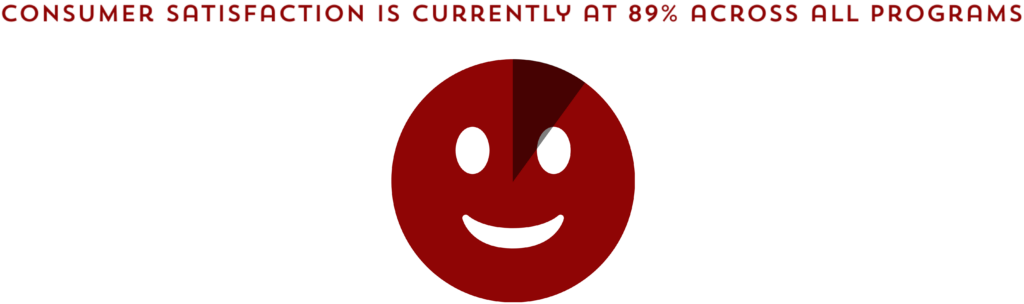
Consumer Satisfaction measures how our members feel about the services that we provide.  Although we have many ways through which our members can give us their feedback, our Consumer Satisfaction surveys are a great way for us to receive input from as many members as possible, at different points throughout the year.  The survey asks our members to rate the services, staff and how they feel the services are impacting their lives.  Our goal is to keep Consumer Satisfaction rates above 85%.
Scroll to Top